
The Israeli Health Ministry reported Monday that 777 people have been evacuated to hospitals since the start of the joint Israeli-U.S. war against Iran.
At least 10 people were killed directly by Iranian missile attacks on Israel, and two died on their way to shelters.
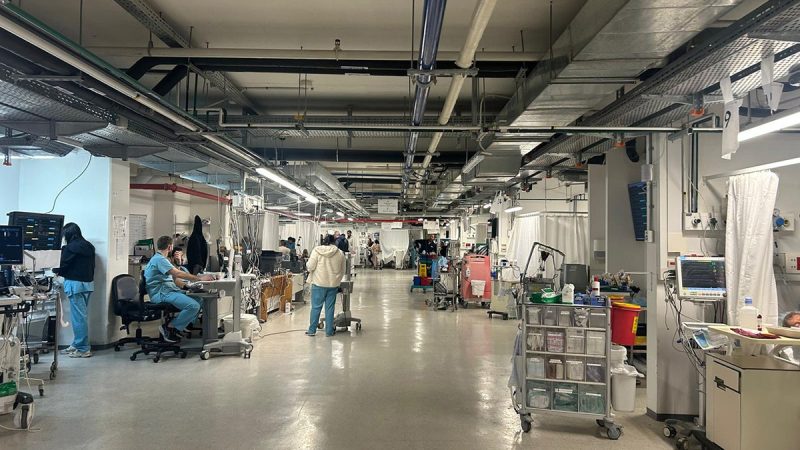
Since fighting began Saturday morning, hospitals nationwide have restructured operations, relocating patients underground to maintain functionality.
‘See, this child,’ professor Efrat Bron-Harlev, CEO of Schneider Children’s Medical Center, told Fox News Digital, pointing to a young patient. ‘This cart is his artificial heart. He has been living here while waiting for a heart transplant. He moved to the underground area together with 119 other children. This is not just a hospital — it’s his home.’
Schneider Children’s Medical Center has so far treated three children injured as a result of the war. The greater challenge, Bron-Harlev said, is continuing to care for all existing patients as missile sirens sound across the country.
All patients have been relocated to level minus one. Standing in a corridor, Bron-Harlev explained that if a missile were to strike at that moment, those present would need to move behind the heavy doors of reinforced areas for protection.
Once sealed, she said, the fortified section is designed to withstand even a direct missile hit and continue operating as a unit for a limited time. ‘We have electricity supplied by large batteries located in another sheltered area, as well as oxygen and air,’ she said. ‘How long we could remain there would depend on the extent of damage to the overall building. A catastrophic strike on the oxygen tanks, for example, would affect how long we could stay.’
Lessons learned from the June 2025, 12-day war include establishing a separate unit for bone marrow transplant patients with an independent ventilation system. Fresh air enters and exits the space without circulating from the regular ward, protecting the children not only from missile threats but also from potential infections from other patients.
In the event of a mass-casualty incident involving severely ill children, the hospital has prepared an intensive care unit capable of accommodating up to 20 patients at a time.
The staff’s underground dining room has been converted into a dormitory for parents. Although there was not enough time to construct fully fortified operating rooms, Bron-Harlev said part of the neonatal intensive care unit has been transformed into a restricted-access surgical area.
‘We are performing only emergency surgeries,’ she said. ‘We have created two provisional but fortified operating rooms that will function until the permanent ones currently under construction are ready. Two are sufficient for now for emergency procedures. I hope we will not face a situation in which 10 children arrive from a major incident needing surgery, but even then, we could operate on them one after the other.’
At the nearby adult hospital, which is part of the same complex — Rabin Medical Center —17 people were treated as a result of the war. The hospital has moved 500 beds 60 meters underground.
Schneider Children’s Medical Center and Rabin Medical Center are two of 14 hospitals operated by Clalit Health Services, the largest healthcare organization in Israel, providing day-to-day primary care, specialty care, and hospital care to over 5 million Israelis.
During the 12-day war, Prof. Ran Balicer, Deputy Director General and Chief of Innovation at Clalit Health Services, told Fox News Digital that a missile targeted Soroka Hospital in Beersheba and hit a building that had fortunately been evacuated the day before.
‘We’ve learned a lesson about the importance of preparing for attacks of Iranians targeting civilians in general and hospitals in particular,’ he said.
In the 24 hours following the start of the war, all patients not in safe areas were moved underground, where staff can focus on care despite the threats. The parking lot, Balicer explained, is more condensed than a normal ward.
‘There are challenges from congestion to infection control and privacy, there are no windows, all of the noise and the pressure is in, it’s a mental and physical strain on the staff, but they are here to do what they vowed to do,’ he said.
The area includes stockpiles of food, oxygen, and medical supplies. The hospital also focuses on virtual care and digital health to provide effective care without requiring patients to come in.
War-associated wounds, Balicer said, include limb injuries and other severe trauma. ‘Our rate of mortality on the frontlines is the lowest compared to anywhere else in the world. As such we have to really be effective in rehabilitation work,’ he said.
The line between the frontlines and the homefront in terms of injuries is no longer clear-cut.
‘They target civilians like they are on the frontlines, they aim deliberately to strike and hurt civilians with weapons that aim to inflict mass-casualty events,’ he said.
Israeli hospitals are also being secured by IDF soldiers deployed to assist with moving patients during missile alerts, if necessary, and to coordinate the arrival of casualties.
Major S., head of operations in the IDF’s search and rescue unit, told Fox News Digital that the forces are preparing for a prolonged campaign.
‘The last operation lasted only 12 days, and it was very significant for our unit, but this time is different,’ she said.
‘Our mindset is that this will not end until it is over for good. As the war continues, we are facing attacks from additional fronts, including Hezbollah in Lebanon and potentially the Houthis in Yemen. We are ready for every scenario,’ she added.